Motivation
Typing has become an increasingly important feature of modern Python. This has changed how we write code, helped prevent errors, and improved the experience of working with modern editors. Pysmo brings these features to the field of seismology.
Tip
In the paragraphs below we use the terms "class" and "type" a lot. We can
explore the relationship between these terms in more detail using the
built-in float type:
- We first assign a float to the variable
a. - Then we verify it is indeed a float using the
typecommand. - The type of the float class is... a type!
This example shows that the type of a class is itself a type, so every time we define a class in Python, we also define a type.
The problem with types in seismology
Anyone who has taken a course on programming (in any language) will most likely first have been taught about the different data types available. These typically consist of simple types like integers, floats, and strings, as well as the more complicated arrays, dictionaries, etc. These types are typically very clearly defined and intuitive to use. For example, we don't need to think very hard whether or not it makes sense to pass the string "hello world" as input to a program that calculates the square root of a number.
As one moves from general-purpose programming towards more specialised problem solving (e.g. within a particular scientific field), the expected input and output for a piece of code is likely to become more complex. We may therefore quite easily reach a point where we no longer have that intuitive feeling about the data we are working with.
When processing seismological data with Python, we naturally want to consider a seismogram to be a Python type of sorts. However, what data that type should include depends on the particular requirements of the processing that is performed with that seismogram data. Thus, if we define a seismogram type based on the needs of one particular application, it might not be suited for another. If we attempt to account for many use cases by being as broad as possible when defining a type, we are again more at risk of losing the intuitive feeling for our type while writing code. This kind of seismogram type would just be an abstract construct, rather than having any meaningful connection with how we experience a seismogram in nature or when treating it mathematically (and still wouldn't be able to guarantee it would work with all possible future use cases!).
File formats in seismology
The challenges we face due to different file formats that exist in seismology, and how they are used for processing, are not dissimilar to what was discussed above. Their design naturally focuses on data storage, but they often try to cater towards applications too. We can use SAC as an example for this; SAC is essentially an application with its own file format. Additionally, SAC files are commonly used as input format for third-party applications. This is possible because SAC files allow storing a lot of metadata in their "headers". The approach does have a few drawbacks though:
- The majority of SAC headers are optional (only 6 are mandatory), so there is no guarantee they are actually set to a value. To prevent this from causing errors, checks need to be built into code to ensure they are actually set.
- The large number of headers (over 150!) requires intricate knowledge of the file format. Even so, using SAC files probably feels far from intuitive.
- SAC files are limited to the headers defined in the format. The only way to store custom data is via the "user defined headers", or if those run out, repurposing other headers to mean something else.
The pysmo solution
As it is impossible to know all possible ways a seismogram might be used in the future, defining an all-encompassing type for a seismogram for any use case is equally impossible (and would be difficult to use anyway). Pysmo instead focuses on what different seismograms have in common to define a seismogram type. This leads to the following approach:
- Seismogram data are stored in any existing or new format (i.e. Python class). We might call this the "data seismogram". Recall also that any class in Python is also a type that can be used in type annotations.
- The attributes all seismograms have in common determine the pysmo type.
Unlike the data seismogram, it is only used for type annotations, so it
doesn't need to be a real class. As mentioned elsewhere,
Protocolclasses are used for this purpose. - Code that requires access to specific attributes or methods of the data seismogram uses that as its type (i.e. as their type annotation).
- Code that only uses the parts of the data seismogram that all seismograms have in common uses pysmo types instead.
This approach gives complete freedom to store and use data in any way, while still being able to write reusable code using pysmo types.
Code writing experience
At this point it is worth remembering that type hints in Python are not enforced at runtime. They are therefore most useful when used together with a modern editor capable of interpreting these type hints. Typically this happens in the form of autocomplete and error checking.
Autocomplete
Once installed, the pysmo types can be
imported and used just like any class. We can, for example, use the
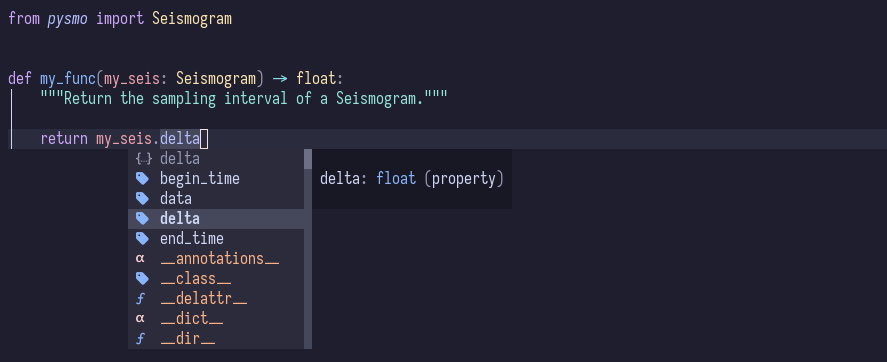
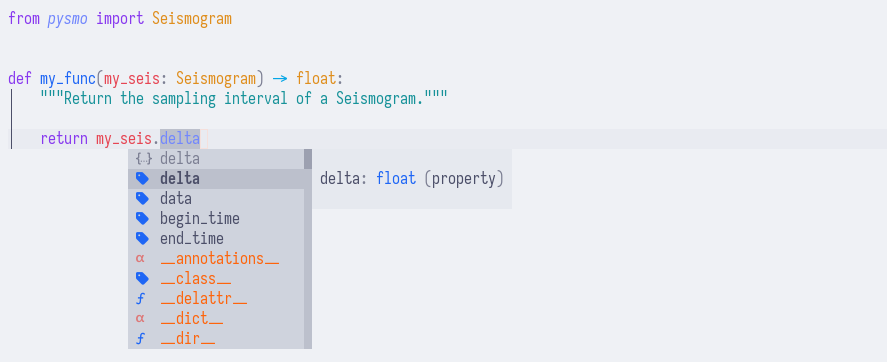
Seismogram type to annotate a function. A modern editor
is then able to tell us what attributes are available for a variable and speed
up the coding process by offering autocomplete for the attributes:
Error checking
Should we for some reason make coding errors such as trying to access a non-existent attribute, the editor will give us a warning:


These kinds of warnings are not just for catching typos. They will also catch
programming errors such as trying to set the value of delta to a string
instead of a float.
Tip
Should your editor for some reason be unable to parse type hints, testing your code for typing errors can still be done with mypy by running: