Generate realistic synthetic noise.
matches the naturally observed amplitude spectrum.
Examples:
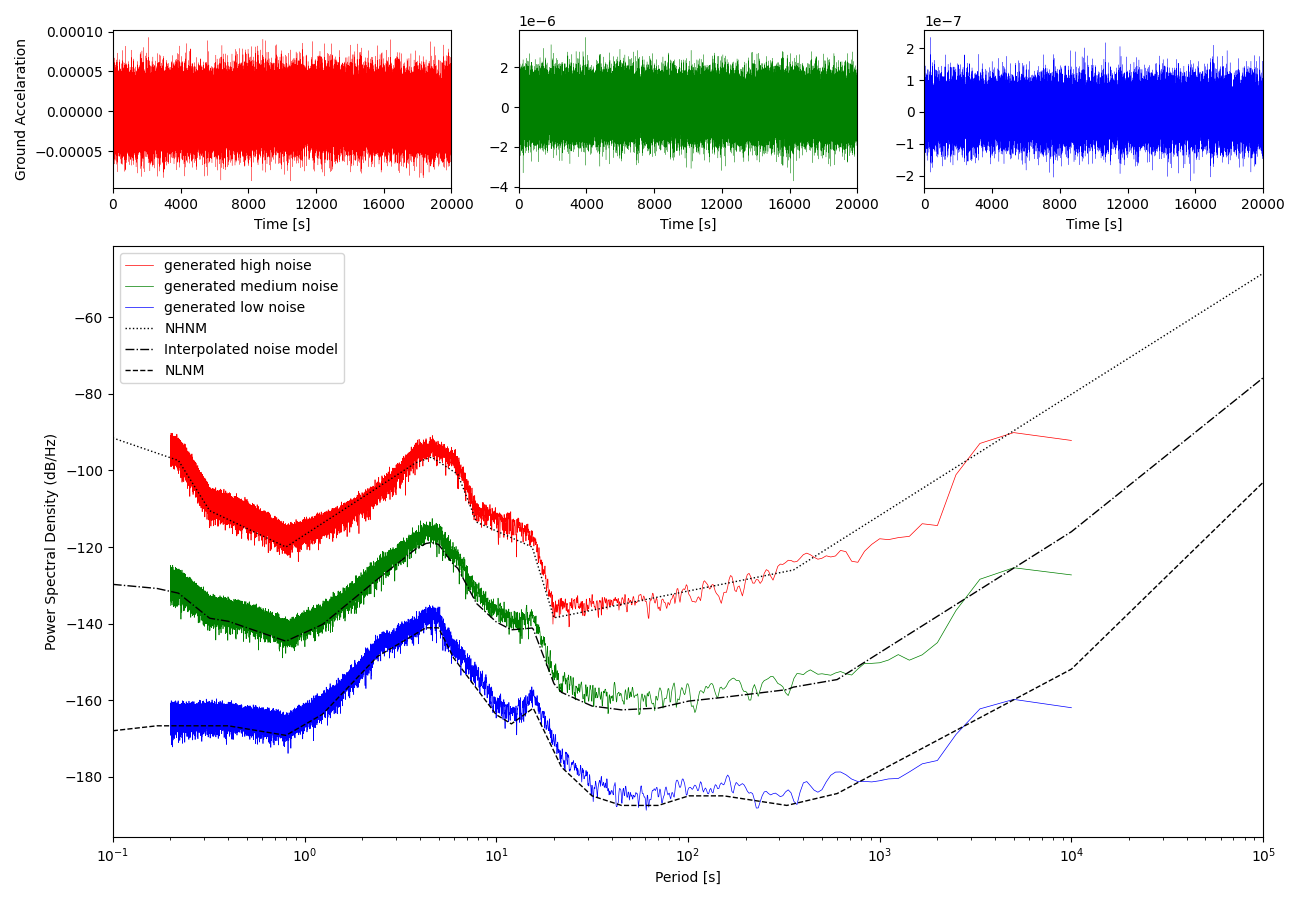
Given the spectral amplitude in observed seismic noise on Earth is not flat (i.e. not consisting of white noise), it makes sense to calculate more realistic noise for things like resolution tests with synthetic data.
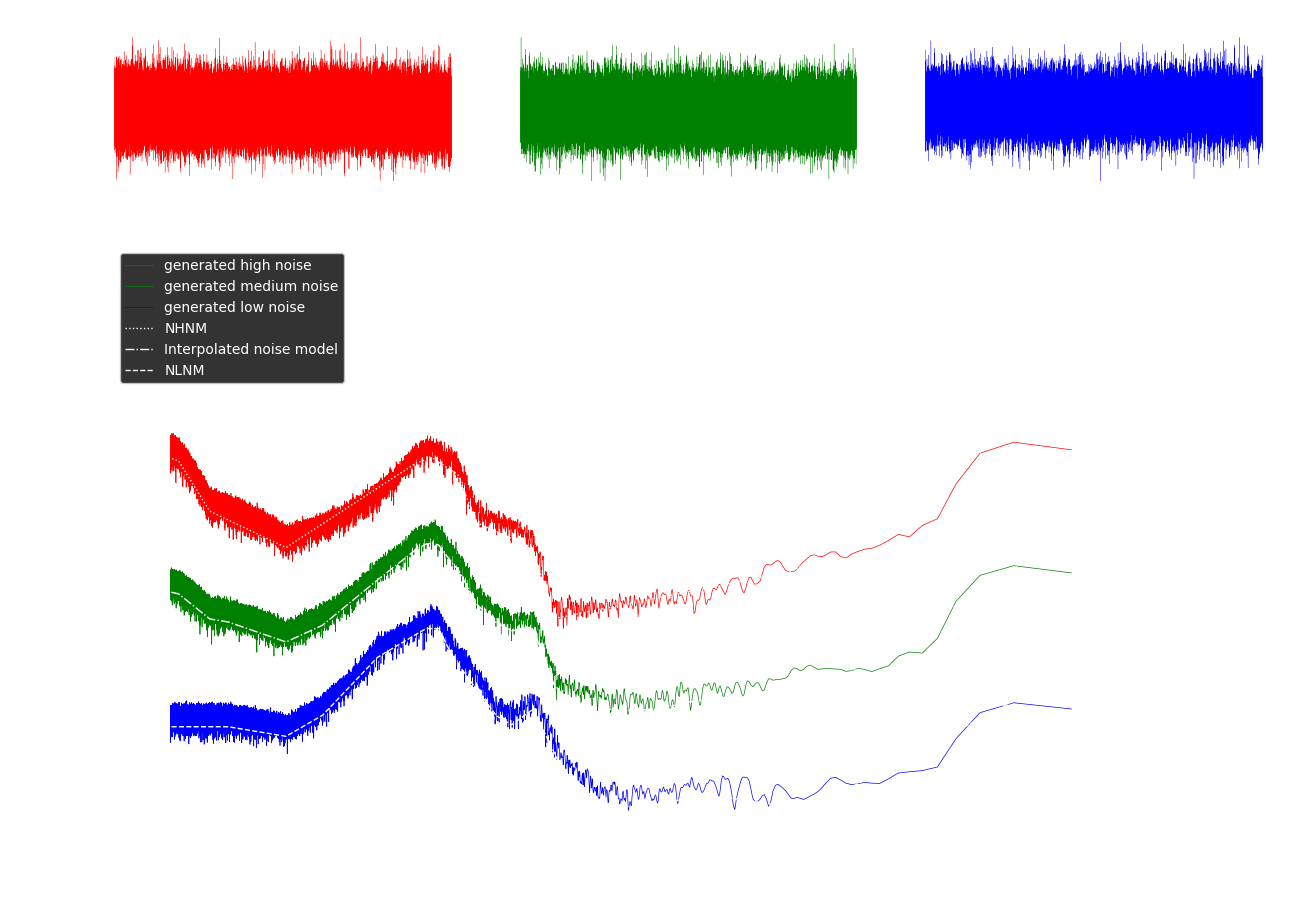
In this example, random noise seismograms are generated from three different noise models. These are Peterson's NHNM (red), NLNM (blue), and an interpolated model that lies between the two (green).
Example source code
"""
Example script for pysmo.tools.noise
"""

#!/usr/bin/env python

import numpy as np
import matplotlib.pyplot as plt
from scipy import signal
from pysmo.tools.noise import generate_noise, peterson
from pandas import Timedelta


def calc_power(
    data: np.ndarray, sampling_frequency: float, nperseg: int, nfft: int
) -> tuple[np.ndarray, np.ndarray]:
    """Calculuate power and drop first element (f=0Hz) to avoid dividing by 0"""
    freqs, psd = signal.welch(
        data, sampling_frequency, nperseg=nperseg, nfft=nfft, scaling="density"
    )
    return freqs[1:], psd[1:]


def main() -> None:
    # Set parameters
    npts: int = 200000  # multiple of 4
    delta = Timedelta(seconds=0.1)
    sampling_frequency = 1 / delta.total_seconds()
    nperseg = int(npts / 4)
    nfft = int(npts / 2)
    time_in_seconds = np.linspace(0, npts * delta.total_seconds(), npts)

    # Calculate noise models
    low_noise_model = peterson(noise_level=0)
    mid_noise_model = peterson(noise_level=0.5)
    high_noise_model = peterson(noise_level=1)

    # Generate random noise seismograms
    low_noise_seismogram = generate_noise(npts=npts, model=low_noise_model, delta=delta)
    mid_noise_seismogram = generate_noise(npts=npts, model=mid_noise_model, delta=delta)
    high_noise_seismogram = generate_noise(
        npts=npts, model=high_noise_model, delta=delta
    )

    # Calculuate power spectral density
    f_low, Pxx_dens_low = calc_power(
        low_noise_seismogram.data, sampling_frequency, nperseg, nfft
    )
    f_mid, Pxx_dens_mid = calc_power(
        mid_noise_seismogram.data, sampling_frequency, nperseg, nfft
    )
    f_high, Pxx_dens_high = calc_power(
        high_noise_seismogram.data, sampling_frequency, nperseg, nfft
    )

    _ = plt.figure(figsize=(13, 9), layout="tight")

    # Plot random high and low noise seismograms
    ax1 = plt.subplot2grid((4, 3), (0, 0))
    plt.plot(time_in_seconds, high_noise_seismogram.data, "r", linewidth=0.2)
    plt.ylabel("Ground Accelaration")
    plt.xlabel("Time [s]")
    plt.xlim(time_in_seconds[0], time_in_seconds[-1])
    xticks = np.arange(
        tmin := time_in_seconds[0], (tmax := time_in_seconds[-1]) + 1, (tmax - tmin) / 5
    )
    ax1.set_xticks(xticks)

    ax2 = plt.subplot2grid((4, 3), (0, 1))
    ax2.set_xticks(xticks)
    plt.plot(time_in_seconds, mid_noise_seismogram.data, "g", linewidth=0.2)
    plt.xlabel("Time [s]")
    plt.xlim(time_in_seconds[0], time_in_seconds[-1])

    ax3 = plt.subplot2grid((4, 3), (0, 2))
    ax3.set_xticks(xticks)
    plt.plot(time_in_seconds, low_noise_seismogram.data, "b", linewidth=0.2)
    plt.xlabel("Time [s]")
    plt.xlim(time_in_seconds[0], time_in_seconds[-1])

    # Plot PSD of noise
    _ = plt.subplot2grid((4, 3), (1, 0), rowspan=3, colspan=3)
    plt.plot(
        1 / f_high,
        10 * np.log10(Pxx_dens_high),
        "r",
        linewidth=0.5,
        label="generated high noise",
    )
    plt.plot(
        1 / f_mid,
        10 * np.log10(Pxx_dens_mid),
        "g",
        linewidth=0.5,
        label="generated medium noise",
    )
    plt.plot(
        1 / f_low,
        10 * np.log10(Pxx_dens_low),
        "b",
        linewidth=0.5,
        label="generated low noise",
    )
    plt.plot(
        high_noise_model.T,
        high_noise_model.psd,
        "k",
        linewidth=1,
        linestyle="dotted",
        label="NHNM",
    )
    plt.plot(
        mid_noise_model.T,
        mid_noise_model.psd,
        "k",
        linewidth=1,
        linestyle="dashdot",
        label="Interpolated noise model",
    )
    plt.plot(
        low_noise_model.T,
        low_noise_model.psd,
        "k",
        linewidth=1,
        linestyle="dashed",
        label="NLNM",
    )
    plt.gca().set_xscale("log")
    plt.xlim(low_noise_model.T[0], low_noise_model.T[-1])
    plt.xlabel("Period [s]")
    plt.ylabel("Power Spectral Density (dB/Hz)")
    plt.legend()
    plt.savefig("peterson.png", transparent=True)
    plt.show()


if __name__ == "__main__":
    main()
Classes:
| Name | Description |
|---|---|
NoiseModel |
Class to store seismic noise models. |
Functions:
| Name | Description |
|---|---|
generate_noise |
Generate a random seismogram from a noise model. Realistic seismic noise is |
peterson |
Generate a noise model by interpolating between Peterson's[^1] |
dataclass
Class to store seismic noise models.
Parameters:
| Name | Type | Description | Default |
|---|---|---|---|
psd
|
ndarray
|
Power spectral density of ground acceleration [dB]. |
(lambda: array([]))()
|
T
|
ndarray
|
Period [seconds]. |
(lambda: array([]))()
|
Source code in src/pysmo/tools/noise.py
generate_noise(
    model: NoiseModel,
    npts: int,
    delta: Timedelta = delta.value,
    begin_time: Timestamp = begin_time.value,
    return_velocity: bool = False,
    seed: int | None = None,
) -> MiniSeismogram
Generate a random seismogram from a noise model. Realistic seismic noise is generated by assigning random phases to a fixed amplitude spectrum prescribed by a noise model.
Parameters:
| Name | Type | Description | Default |
|---|---|---|---|
model
|
NoiseModel
|
Noise model used to compute seismic noise. |
required |
npts
|
int
|
Number of points of generated noise |
required |
delta
|
Timedelta
|
Sampling interval of generated noise |
delta.value
|
begin_time
|
Timestamp
|
Seismogram begin time |
begin_time.value
|
return_velocity
|
bool
|
Return velocity instead of acceleration. |
False
|
seed
|
int | None
|
set random seed manually (usually for testing purposes). |
None
|
Returns:
| Type | Description |
|---|---|
MiniSeismogram
|
Seismogram with random seismic noise as data. |
Source code in src/pysmo/tools/noise.py
peterson(noise_level: float) -> NoiseModel
Generate a noise model by interpolating between Peterson's1 New Low Noise Model (NLNM) and New High Noice Model (NHNM).
-
Peterson, Jon R. Observations and Modeling of Seismic Background Noise. Report, 93–322, 1993, https://doi.org/10.3133/ofr93322. USGS Publications Warehouse. ↩
Parameters:
| Name | Type | Description | Default |
|---|---|---|---|
noise_level
|
float
|
Determines the noise level of the generated noise model. A noise level of 0 returns the NLNM, 1 returns the NHNM, and anything > 0 and < 1 returns an interpolated model that lies between the NLNM and NHNM. |
required |
Returns:
| Type | Description |
|---|---|
NoiseModel
|
Noise model. |